

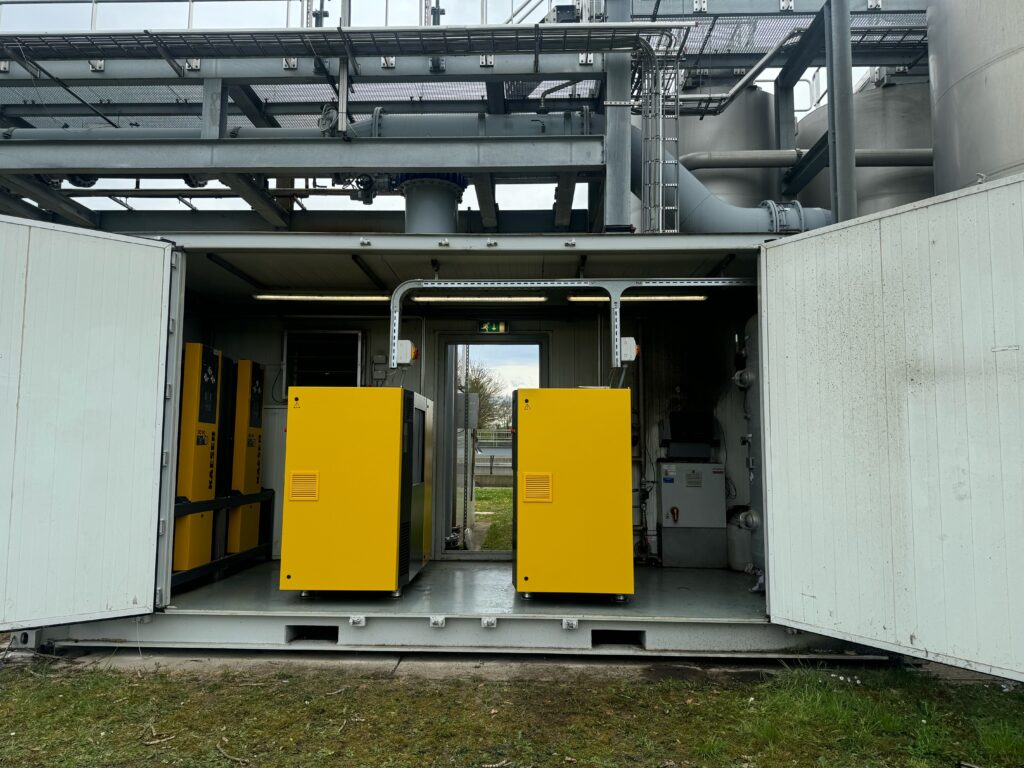
HOW WE BUILT A FULLY REDUNDANT COMPRESSED AIR STATION IN A CONTAINER UNIT FOR HEAVY INDUSTRY
Some projects require a solution that goes beyond a standard compressor room. When an industrial site does not offer a suitable indoor space, the environment is harsh, and operational reliability must be absolutely guaranteed, a container unit is the most professional and robust choice. SK Compressor Service built a fully self-contained, climate-controlled compressed air station for a major industrial client—fully integrated into a container unit that was installed on-site as a plug-and-play solution.
The result: a redundant compressed air system that operates independently of the factory building, is resistant to outdoor conditions, and is managed fully automatically by the most advanced compressor management software offered by Kaeser—the SAM 4.0 Sigma Air Manager.
THE SITUATION: COMPRESSED AIR AT A SITE WHERE NO COMPRESSOR ROOM WAS AVAILABLE
The customer—a major player in heavy industry—faced a specific challenge. The production site did not have a suitable indoor space for a compressor installation. Building a new compressor room would be time-consuming and costly. The site required a solution that could be deployed quickly, operate completely independently, and withstand the outdoor conditions of a harsh industrial environment.
In addition, the requirements for operational reliability and air quality were high. Downtime of the compressed air system was not an option—the production processes are entirely dependent on a continuous supply of compressed air. And the compressed air had to meet strict dryness specifications.
The solution proposed by SK Compressor Service: a fully integrated compressed air station housed in a container unit—designed, built, and installed as a single, complete, ready-to-use unit.
THE CONFIGURATION: TWO KAESER ASD50 UNITS WITH SAM 4.0 — MAXIMUM RELIABILITY
Complete Technical Configuration
| Component | Type / Specifications | Position |
|---|---|---|
| Screw Compressor 1 | Kaeser ASD50 — 25 kW | Main compressor, SIGMA PROFIL rotor, built-in cooling |
| Screw Compressor 2 | Kaeser ASD50 — 25 kW | Redundant compressor, automatic failover |
| Control System | SAM 4.0 Sigma Air Manager | Centralized intelligent control of both compressors |
| Dryer 1 | DC Absorption Dryer | Ultra-dry air — dew point as low as -40°C |
| Dryer 2 | DC Absorption Dryer | Redundant drying, continuous supply of dry air guaranteed |
| Condensate Treatment 1 | Aquamat CF9 | Oil/Water Separation Compressor 1 |
| Condensate Treatment 2 | Aquamat CF9 | Oil/Water Separation Compressor 2 |
| Piping | Stainless Steel Piping System | Corrosion-free, hygienic, leak-free internal piping system |
| Housing | Container unit — fully insulated | Climate control, weatherproof, plug-and-play |
Are you already saving as much as you can?
SK Compressor Service inspects your compressed air system using professional ultrasonic equipment. You will receive a comprehensive leak report that includes locations, estimated losses, and priority rankings.
FIVE TECHNICAL DECISIONS THAT MAKE THIS PROJECT SPECIAL
01 — Kaeser ASD50: Powerful, Compact, and Reliable
The Kaeser ASD50 is a 25 kW screw compressor from the ASD series—designed for heavy-duty industrial use. The patented SIGMA PROFIL rotors deliver maximum energy efficiency at any load, while the robust construction ensures a long service life under harsh conditions. With two identical machines in the container unit, 100% reserve capacity is always available—one machine can take over the entire load if the other is undergoing maintenance or is out of service. Learn more about the Kaeser ASD series at nl.kaeser.com.
02 — SAM 4.0 Sigma Air Manager: the brain of the system
The SAM 4.0 is Kaeser’s most advanced compressor management system and the absolute heart of this installation. Whereas a standard Sigma Control monitors the individual machine, the SAM 4.0 coordinates the entire installation as a single system. The SAM 4.0 continuously monitors and optimizes:
- Rotation Distribution — automatic distribution of operating hours between both compressors to ensure even wear
- Energy Optimization — Always ensures that the most energy-efficient combination of machines is in operation based on current air demand
- Predictive maintenance — maintenance intervals are tracked and reported before a problem arises
- Remote monitoring — comprehensive remote monitoring via the Kaeser SIGMA NETWORK
- Automatic failover — if one machine fails, the other automatically and immediately takes over
The SAM 4.0 combines two separate compressors into a single intelligent, self-contained system that manages itself. Learn more about the Kaeser Sigma Air Manager.
03 — DC Absorption Dryer: Ultra-Dry Air for Critical Processes
Whereas a standard refrigeration dryer dries compressed air to a dew point of +3°C, a DC absorption dryer goes much further—down to a dew point of -40°C or lower. This is essential for applications where condensation in the piping system must be absolutely prevented: at low ambient temperatures, over long pipe runs, or in moisture-sensitive process applications. The choice of DC dryers in this containerized system ensures that the compressed air is always dry—even with fluctuating outdoor temperatures and high relative humidity.
04 — Dual Aquamat CF9: Environmentally Safe Condensate Treatment
Every compressor produces condensate that contains traces of oil and contaminants. The Aquamat CF9 separates oil and water using an activated carbon filter cartridge and discharges the purified water in an environmentally safe manner. With one Aquamat per compressor, condensate treatment is fully redundant—even if one unit is undergoing maintenance, the condensate from the other compressor is always treated properly.
05 — Stainless steel piping system: corrosion-free and leak-proof
The internal piping system in the container unit is made of stainless steel. In an environment with high humidity, temperature fluctuations, and potentially corrosive substances in the outside air, stainless steel is the only sensible choice. No corrosion, no leaks due to rust, no contamination of the compressed air caused by pipe wall degradation—and a significantly longer service life than alternative materials. Learn more about our compressed air piping made of stainless steel and other materials.
LOGISTICS AND INSTALLATION: FROM PRODUCTION TO PLUG-AND-PLAY DELIVERY
A container-based installation requires a different logistical approach than a standard indoor installation. The machines must be delivered, assembled inside the container, connected internally, and tested—before the container is transported to its final location. SK Compressor Service coordinated the entire process.
Step 1 — Engineering and Container Design The container design was tailored to the two Kaeser ASD50 machines, the dryers, the condensate treatment system, and the SAM 4.0 system. Climate control, ventilation, escape routes, air vents, and cable entries were all incorporated into the design. Every detail—from the positioning of the machines to the routing of the stainless steel piping—was determined in advance.
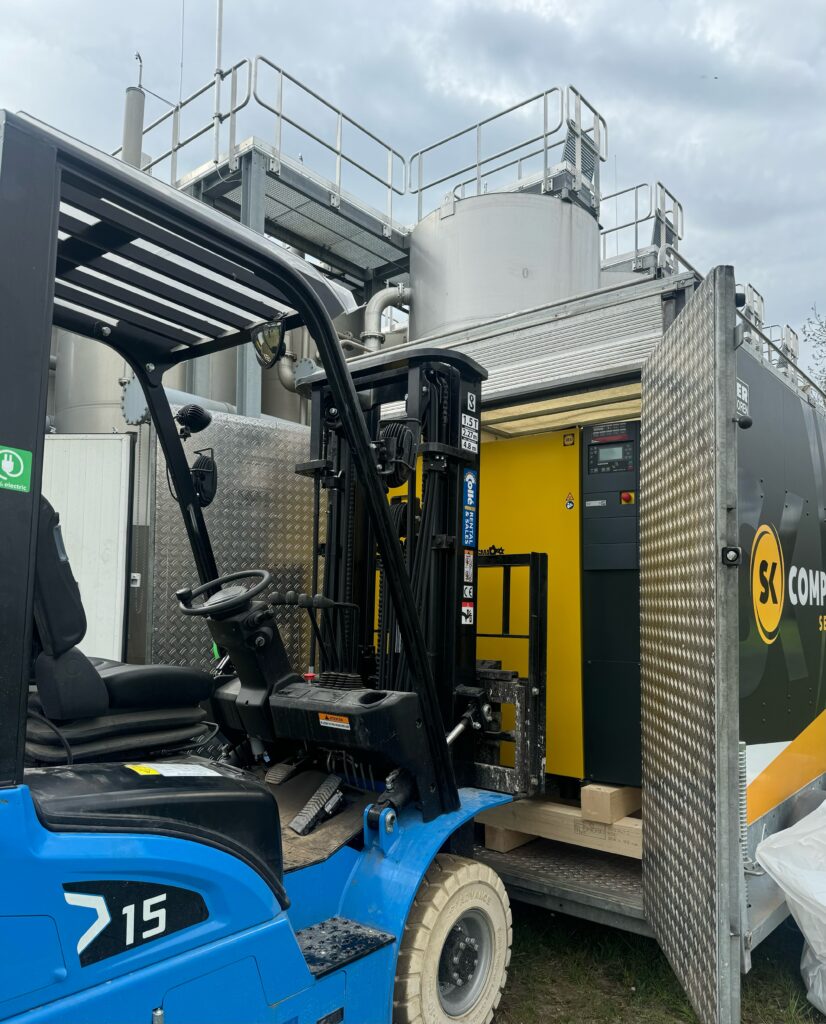
Step 2 — Delivery of the Machines The Kaeser ASD50 compressors were transported using SK Compressor Service’s company truck and placed inside the container unit on site using a forklift. Precision work: the machines had to be positioned exactly where they were intended to be placed for the connections to the stainless steel piping system.
Step 3 — Installation and Wiring After installation, both ASD50 units were electrically connected and linked to the SAM 4.0 Sigma Air Manager. The DC desiccant dryers, Aquamat CF9 condensate drains, and the complete stainless steel internal piping system were installed and connected.
Step 4 — SAM 4.0 Configuration The Sigma Air Manager was configured for the specific situation: load distribution, pressure bands, maintenance intervals, alarm limits, and remote monitoring parameters. Both compressors were commissioned as a single system and tested for proper communication with each other and automatic failover.
Step 5 — Pressure Test, Functional Test, and Acceptance After full installation, the system underwent extensive testing: a pressure leak test on the internal piping network, a functional test of the automatic failover, a check of the dryer dew points, and verification of the SAM 4.0 monitoring. After successful testing, the container unit was handed over to the customer—complete with documentation, a configuration report, and instructions on how to operate the SAM 4.0 system.
THE RESULT: A STANDALONE, REDUNDANT COMPRESSED AIR STATION THAT MANAGES ITSELF
| Aspect | Result |
|---|---|
| Total Installed Capacity | 50 kW (2 × 25 kW) |
| Availability of the compressed air system | 100% redundant — no single point of failure |
| Air Quality | Ultra-dry using a DC absorption dryer — dew point down to -40°C |
| Condensate Treatment | Environmentally safe with 2× Aquamat CF9 |
| Control System | SAM 4.0 — Fully Automated and Accessible Remotely |
| Piping | Stainless steel — corrosion-resistant and low-maintenance |
| Location | Outdoors, in a container unit — no indoor space required |
| Completion | Turnkey — plug-and-play after container installation |
The customer now has a compressed air system that literally operates on a plug-and-play basis: the container is installed, the electrical connection and the compressed air line to the production process are set up, and the system starts up automatically and manages itself via the SAM 4.0. No operator required, no manual switching, and no single point of failure.
WHEN SHOULD YOU CHOOSE A CONTAINERIZED COMPRESSED AIR STATION?
Not every location is suitable for a traditional compressor room. A container-based system is the most appropriate solution in the following situations:
- No indoor space available — The production hall or factory building does not have room for a compressor system. Place the container outside, next to the building.
- Temporary or relocatable installation — The container can be moved to a new location if business conditions change.
- Harsh outdoor environments — Chemical environments, ports, refineries, or water treatment plants where a standard compressor cannot withstand the environmental conditions.
- Maximum operational reliability is required — With redundant compressors and a SAM 4.0 management system, the compressed air station is never dependent on a single machine.
- Quick Deployment — The container is fully assembled and tested before it is shipped to the site. As a result, installation and commissioning are completed in no time.
Do you have a location where a standard compressor room isn't feasible? SK Compressor Service can advise you on the options for a custom container solution. Be sure to check out our other compressed air system case studies for more examples of complex projects.
What is the advantage of a containerized compressed air station over a permanent installation?
A container-based system is completely self-contained, weatherproof, and requires no indoor space. The container is fully assembled and tested in the workshop—including all connections and settings—and then transported to the site as a single, ready-to-use unit. This saves installation time on site and ensures that everything is working properly before installation.
What exactly does the SAM 4.0 Sigma Air Manager do?
The SAM 4.0 is Kaeser’s central management system for multiple compressors. It coordinates the operation of the compressors, continuously optimizes energy consumption based on current air demand, distributes operating hours evenly, and detects malfunctions early. All parameters can be monitored and adjusted remotely via the Kaeser SIGMA NETWORK—the compressors are visible to the administrator anytime, anywhere.
Why choose DC absorption dryers over conventional refrigeration dryers?
A refrigeration dryer dries compressed air to a dew point of approximately +3°C—sufficient for most applications. A DC desiccant dryer achieves dew points of -40°C or lower. This is necessary for applications that are sensitive to condensate, for piping systems in outdoor environments, or for processes with strict air quality requirements. In a containerized system with fluctuating outdoor temperatures, the DC dryer is the safest choice. Learn more about air quality and compressed air analysis.
Can SK Compressor Service also design and build a custom container-based system?
Yes. We design and build fully customized container systems—from the selection of compressors and peripheral equipment to the container layout, climate control, piping, and controls. Please contact us via our contact form or call us directly for a no-obligation consultation.
How is the container facility maintained?
Maintaining the Kaeser ASD50 units in the container is just as easy as maintaining them in an indoor installation. The container has an access door for technicians, and all service points are easily accessible. SK Compressor Service performs periodic maintenance in accordance with Kaeser’s service specifications—the SAM 4.0 automatically notifies you when maintenance is required.
Free advice
Are you already saving as much as you can?
SK Compressor Service inspects your compressed air system using professional ultrasonic equipment. You will receive a comprehensive leak report that includes locations, estimated losses, and priority rankings.