
HOW WE COMPLETELY REPLACED AN OBSOLETE COMPRESSED AIR STATION WITHOUT A SINGLE HOUR OF PRODUCTION DOWNTIME
When a compressed air station reaches the end of its technical and economic lifespan, waiting for a breakdown is not an option. Especially not when production runs 24/7 and every hour of downtime costs money immediately. For one of our industrial customers, this was precisely the situation they were facing: an outdated compressed air station that could no longer meet current air demand, consumed too much energy, and offered insufficient reliability for the future.
Our mission: to demolish the existing station, build a completely new, modern compressed-air station, and bring it online—without halting production for even a moment.
THE SITUATION: A STATION NEAR THE END OF ITS LIFESPAN
The customer’s existing compressed air station had seen better days. This was not so much due to a single major malfunction, but rather to a combination of factors that, taken together, resulted in an inefficient, unreliable, and costly compressed air supply:
- Capacity Mismatch — The company’s air demand had grown over the years, but the system had not kept pace. The station could barely meet the required volume and pressure during peak periods.
- High energy consumption — Older compressors without modern control technology almost always run at full power, even when air demand is low. This resulted in consistently excessive electricity consumption.
- No climate control in the compressor room — Fluctuating temperatures in summer and winter directly affect the performance and service life of compressors. The room did not have controlled ventilation.
- Increasing Maintenance Burden — The frequency of breakdowns and necessary maintenance had increased. Every hour of downtime costs the customer money directly.
- No communication between machines — The existing setup lacked intelligent coordination, which led to unnecessary periods of full-load operation and additional wear and tear.
The conclusion was clear: a partial solution no longer made sense. A completely new compressed air station was the only path to a reliable, energy-efficient future.
THE SOLUTION: A COMPLETELY NEW COMPRESSED AIR STATION WITH A KAESER ASK40T CONFIGURATION
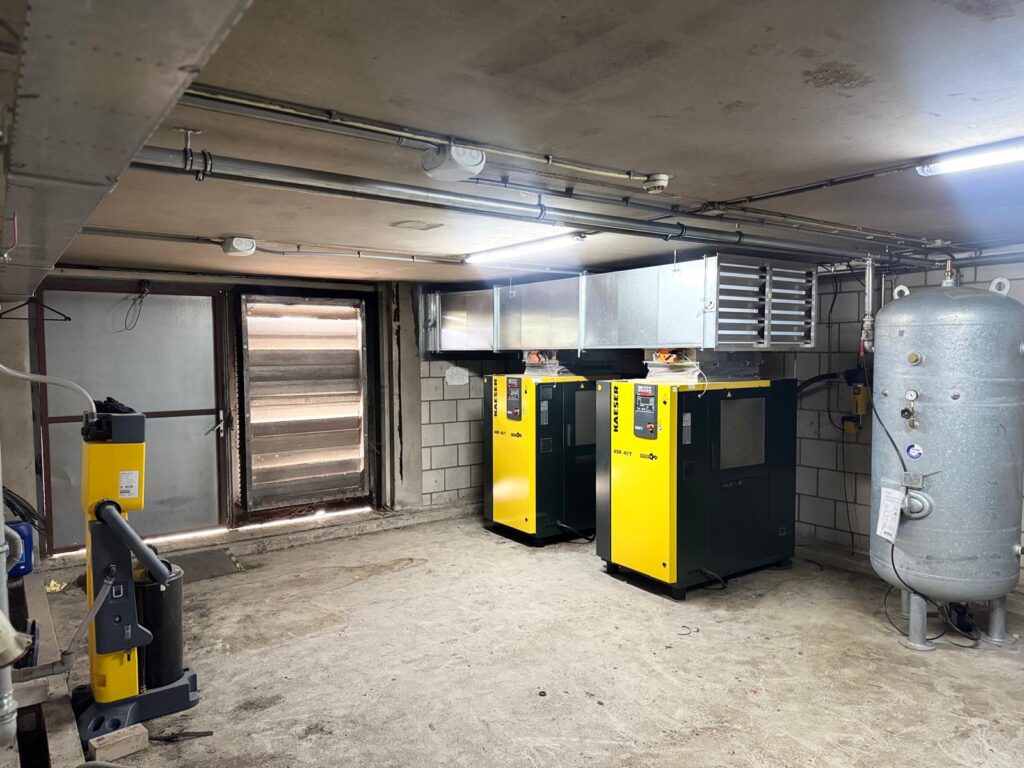
After a thorough assessment of the air demand, the consumption profile, and the spatial layout, we designed a completely new compressed air station. The configuration is built around two identical Kaeser ASK40T screw compressors that work together intelligently via the integrated Sigma Control system.
The complete technical configuration
| Component | Type / Specifications | Position |
|---|---|---|
| Screw Compressor 1 | Kaeser ASK40T — 22 kW | Main compressor with internal refrigeration dryer |
| Screw Compressor 2 | Kaeser ASK40T — 22 kW | Slave compressor, parallel operation via Sigma Control |
| Control System | Kaeser Sigma Control (both machines) | Internal communication, shift scheduling, fault monitoring |
| Compressed Air Filter | KE46 with Eco-Drain 31 | Oil and dust filtration, automatic condensate drainage |
| Compressed Air Tank | 900 liters | Buffering of peaks in air demand, pressure stabilization |
| Condensate Treatment | Aquamat CF10i | Oil/water separation, environmentally safe condensate discharge |
| Piping | Geberit Mapress System | Leak-free compressed air piping system to production halls |
| Climate Control | Automatic Summer/Winter Ventilation | Optimal compressor room temperature year-round |
Are you already saving as much as you can?
SK Compressor Service inspects your compressed air system using professional ultrasonic equipment. You will receive a comprehensive leak report that includes locations, estimated losses, and priority rankings.
FOUR TECHNICAL DECISIONS THAT MAKE A DIFFERENCE
01 — Kaeser ASK40T with internal refrigeration dryer
The Kaeser ASK40T is a compact, powerful 22-kW screw compressor with a built-in refrigeration dryer. This is a deliberate design choice: by integrating the dryer into the machine unit, there is no need for a separate dryer, which saves installation space and keeps operating costs low. The patented SIGMA PROFILE rotors ensure maximum energy efficiency—up to 15% more efficient than conventional rotor geometry. Learn more about the technology behind Kaeser screw compressors.
02 — Sigma Control: Two Machines, One Brain
At the heart of this compressed air station is the Sigma Control system installed on both machines. Through mutual communication, each compressor knows exactly what the other is doing. The control system automatically determines which machine operates as the lead compressor and which as the slave—based on the current air demand. This means: an even distribution of operating hours across both machines, less wear and tear, automatic failover in the event of a malfunction, and no more capacity surpluses or shortages. The system continuously optimizes itself.
03 — Aquamat CF10i: Environmentally Safe Condensate Treatment
Compressed air condensate isn’t just water—it contains oil and other contaminants that cannot simply be discharged into the sewer system. The Aquamat CF10i separates oil and water using an activated carbon filter and discharges the purified water cleanly. This is not only environmentally responsible; it is also required by law. This is a detail that is often overlooked in many installations—resulting in potential fines and environmental liability.
04 — Automatic summer/winter control for the compressor room
Compressors perform best within a certain temperature range. If it’s too cold in the winter, startup is delayed and condensation increases. If it’s too hot in the summer, the oil and cooling water temperatures rise, which can trigger thermal protection. We installed an automatically controlled ventilation system that keeps the compressor room at the right temperature year-round—without anyone having to monitor it.
HOW WE INSTALLED THE NEW STATION WITHOUT INTERRUPTING PRODUCTION
The biggest challenge of this project was not technical—it was logistical. The old station had to be demolished and the new one installed while the customer’s production continued as usual. Each phase required careful planning and coordination.
Step 1 — Assessment and Preparation
Before implementation, we assessed the entire situation: the layout, the compressed air demand per production line, the electrical connection, and the options for a temporary compressed air supply during the transition. Based on this, we drew up a detailed project plan.
Step 2 — Temporary Compressed Air Supply
To ensure production continued during the installation period, a temporary rental compressor was used. This allowed the old station to be demolished without the production lines ever having to shut down, even for a moment.
Step 3 — Removing the Old Drive
The outdated station was professionally dismantled and removed—including the old pipes and peripheral equipment.
Step 4 — Installation of a New Compressed Air Station
The two Kaeser ASK40T units were installed and electrically connected. The Aquamat CF10i condensate treatment unit, the 900-liter compressed air receiver, and the KE46 filter were installed and connected to the new Geberit Mapress piping system.
Step 5 — Geberit Mapress Piping
The new Geberit Mapress piping system was professionally installed in the production halls. Mapress is a press-fit connection system that is completely leak-proof, quick to install, and requires no welding—ideal for compressed air in production environments.
Step 6 — Sigma Control Configuration and Integration
The Sigma Control systems on both machines were configured and linked together. The master and slave settings were adjusted to match the customer's consumption profile.
Step 7 — Climate Control Installation
The automatic summer/winter control system for the compressor room was installed and calibrated—with the correct setpoints for both summer and winter conditions.
Step 8 — Pressure Testing, Commissioning, and Acceptance
After the installation was complete, we conducted a comprehensive pressure and leak test on the entire piping system. Following a successful test, the station was put into operation and handed over to the customer—complete with a commissioning report and instructions on how to operate it via the Sigma Control displays.
THE RESULT: MORE CAPACITY, LESS ENERGY, ZERO DOWNTIME
| Result | Previous situation | New Situation |
|---|---|---|
| Capacity | Insufficient during peak demand | More than enough + reserve capacity |
| Energy Consumption | High due to constant full load | Significantly lower due to demand-driven regulation |
| Climate Control | None | Automatically managed year-round |
| Inter-machine communication | None | Entirely via Sigma Control |
| Condensate Treatment | Unknown/not environmentally safe | Certified as environmentally safe through Aquamat CF10i |
| Production Shutdown During Installation | — | Zero hours |
The new compressed air station provides the customer with a system that is tailored to today’s actual air demand and scalable for the future. The two Kaeser ASK40T units automatically alternate based on demand—ensuring that no unit experiences unnecessary wear and that the compressed air system’s overall availability is maximized.
The demand-driven control system via Sigma Control ensures that the compressors only run at full load when it is truly necessary. Outside of peak periods, the system automatically switches to a lower load—which is immediately reflected in the energy bill.
“A compressed air station is only truly effective when you no longer have to worry about it. That’s exactly what we’ve achieved for this customer.” — SK Compressor Service
WHY COMPANIES CHOOSE SK COMPRESSOR SERVICE FOR PROJECTS LIKE THESE
A project like this—carried out entirely during production hours, without any downtime, and involving a technically complex configuration—requires a partner who understands the difference between planning and actually delivering. This is why customers turn to us for these types of projects:
- Turnkey project — From the demolition of the old station to the commissioning and handover of the new one: we handle everything.
- Official Kaeser Dealer — Direct access to genuine Kaeser parts, manufacturer's warranty, and in-depth brand knowledge. Learn more about Kaeser compressors.
- Zero hours of production downtime — Through smart planning and the use of temporary rental capacity, we ensure business continuity during the project.
- Complete compressed air treatment — Compressor, dryer, filter, condensate treatment, piping, and climate control: everything from a single source.
- Sigma Control Expertise — We configure and integrate Kaeser Sigma Control systems for maximum efficiency and reliability.
- NEN-3140 certified — All electrical connections and work equipment are installed and documented in accordance with the standard.
Can a compressed air station be replaced without interrupting production?
Yes, provided it is properly planned. During the installation period, SK Compressor Service provides a temporary rental compressor as a stopgap measure, so your production lines can continue to operate while the old station is dismantled and the new one is installed. Planning and coordination are key to success—and that’s exactly what we specialize in. Learn more about our temporary compressor rental services.
What is the difference between a lead and a slave compressor in a Sigma Control configuration?
In a dual-compressor configuration with Kaeser Sigma Control, the lead compressor is the unit that starts up first and handles the base load. The slave compressor automatically kicks in as soon as the air demand exceeds what the lead compressor can supply on its own. The Sigma Control automatically switches the roles periodically—ensuring that both machines wear evenly and maximizing the system’s overall service life.
Why is the Aquamat CF10i required for a compressed air system?
Compressed air condensate always contains traces of oil and contaminants from the compressor. By law, this condensate may not be discharged untreated into the sewer system. The Aquamat CF10i separates oil and water using an activated carbon filter and discharges the purified water in an environmentally safe manner. This is not only a legal requirement—it also prevents liability in the event of an environmental inspection.
Why is the Aquamat CF10i required for a compressed air system?
Compressed air condensate always contains traces of oil and contaminants from the compressor. By law, this condensate may not be discharged untreated into the sewer system. The Aquamat CF10i separates oil and water using an activated carbon filter and discharges the purified water in an environmentally safe manner. This is not only a legal requirement—it also prevents liability in the event of an environmental inspection.
Why choose Geberit Mapress as a piping system?
Geberit Mapress is a press-fit connection system that creates a completely leak-proof connection without welding or soldering. This makes it ideal for compressed air: installation is faster than with traditional piping, no open flames are required in the production area, and the connections can be tested immediately after installation. The system is also highly expandable—which is convenient if your production grows in the future.
How long will a Kaeser ASK40T last with proper maintenance?
With periodic maintenance in accordance with Kaeser’s service specifications, a Kaeser screw compressor has an average technical service life of 15 to 20 years. The ASK40T is designed for continuous industrial use and is known for its robust construction and low failure rate. As an official Kaeser dealer, SK Compressor Service performs maintenance using genuine parts—ensuring that your warranty remains fully valid. Learn more about our compressor maintenance services.
Free advice
Are you already saving as much as you can?
SK Compressor Service inspects your compressed air system using professional ultrasonic equipment. You will receive a comprehensive leak report that includes locations, estimated losses, and priority rankings.